🎓 ADMISSIONS OPEN 2026–27: Paramedical Diplomas (DMLT, OT, Radiology), ITI Trades & Beauty Courses. Helpline: +91 92630 88987
⚡ Clinical Internships: Practical Hospital Rotations with Tata Main Hospital & Sadar Hospital network
📜 Digital Vault: Permanent Cloud Verified Academic Marksheets & Digital Transcripts
🤝 Study Centre Affiliation: Applications invited for District Franchise Partnerships across Jharkhand & Pan-India
🎓 ADMISSIONS OPEN 2026–27: Paramedical Diplomas (DMLT, OT, Radiology), ITI Trades & Beauty Courses. Helpline: +91 92630 88987
⚡ Clinical Internships: Practical Hospital Rotations with Tata Main Hospital & Sadar Hospital network
📜 Digital Vault: Permanent Cloud Verified Academic Marksheets & Digital Transcripts
🤝 Study Centre Affiliation: Applications invited for District Franchise Partnerships across Jharkhand & Pan-India
Career Decision Guide
DMLT vs BMLT — Which is the Best Choice for Kerala & Tamil Nadu Students?
A transparent comparison of duration, financial investment, practical exposure, and career turnaround time.
| Comparison Parameter |
DMLT (Diploma in Medical Lab Technology) |
BMLT (Bachelor in Medical Lab Technology) |
| Program Duration |
2 Years (Fast job entry) |
3 to 4 Years (Longer study cycle) |
| Total Tuition Cost |
₹70,000 – ₹80,000 Total (Affordable) |
₹2,00,000 – ₹4,50,000 Total |
| Practical Diagnostic Focus |
70% Lab Practical & Hospital Rotations |
50% Theoretical Academics / 50% Lab |
| Starting Salary Potential |
₹18,000 – ₹32,000/mo in India; ₹85K–₹1.5L in Gulf |
₹20,000 – ₹35,000/mo in India |
| Gulf Licensing Eligibility |
Eligible for DHA, MOH & Prometric Technician Exams |
Eligible for Technologist Exams |
| Best Suited For |
Students wanting fast financial independence & early Gulf migration |
Students aiming for academic research & teaching careers |
Academic Curriculum Breakdown
Complete 2-Year DMLT Academic & Practical Syllabus
Designed to align seamlessly with National Paramedical Councils, Kerala State Paramedical Board, and Tamil Nadu MRB exam requirements.
📖 Year 1: Foundational Sciences & Routine Diagnostics
Part 1
- Anatomy & Physiology: Major organ systems, circulatory physiology, urinary system, cellular histology basics.
- Clinical Hematology: Blood collection (Venipuncture & Phlebotomy), Hemoglobin estimation (Sahli's & Cyanmethemoglobin), Total RBC, WBC, and Platelet counting, ESR determination (Wintrobe & Westergren).
- Peripheral Blood Smear: Preparation, Leishman & Giemsa staining, Differential Leukocyte Count (DLC), and abnormal morphology detection.
- Routine Clinical Pathology: Urine physical, chemical, and microscopic examination (Protein, Glucose, Ketones, Pus cells, Casts), Stool examination for ova and cysts.
- General Microbiology: Sterilization techniques (Autoclave, Hot Air Oven), Gram staining, Acid-Fast Staining (AFB for Tuberculosis), Microscope maintenance.
- Introductory Biochemistry: Standard solution preparation, pH metrics, Colorimetry, Photometry fundamentals.
🔬 Year 2: Advanced Clinical Diagnostics & Blood Banking
Part 2
- Advanced Clinical Biochemistry: Liver Function Tests (Bilirubin, SGOT, SGPT, Alkaline Phosphatase), Kidney Function Tests (Urea, Creatinine, Uric Acid), Lipid Profile, Blood Glucose (Fasting, PP, HbA1c).
- Immunohematology & Blood Banking: ABO and Rh blood grouping, Cross-matching (Major & Minor), Coombs test (Direct & Indirect), Blood component separation (PRBC, FFP, Platelets).
- Systematic Medical Bacteriology: Culture media preparation (Blood Agar, MacConkey Agar), Bacterial identification of Staph, Strep, E. coli, Salmonella, Antibiotic Sensitivity Testing (Kirby-Bauer AST).
- Medical Parasitology & Mycology: Malaria detection (QBC, Peripheral Smear), Fungal microscopy (KOH mount).
- Histotechnology & Cytology: Tissue fixation (10% Formalin), Paraffin block embedding, Rotary microtome sectioning, Hematoxylin & Eosin (H&E) staining.
- Laboratory Automation & Quality Control: Calibration of semi-auto & fully-automated biochemistry analyzers, Bio-Rad QC tracking, NABL laboratory compliance standards.
🛠️ 100% Practical Mastery
Live Diagnostic Lab Instrumentation Trained at TMIPS
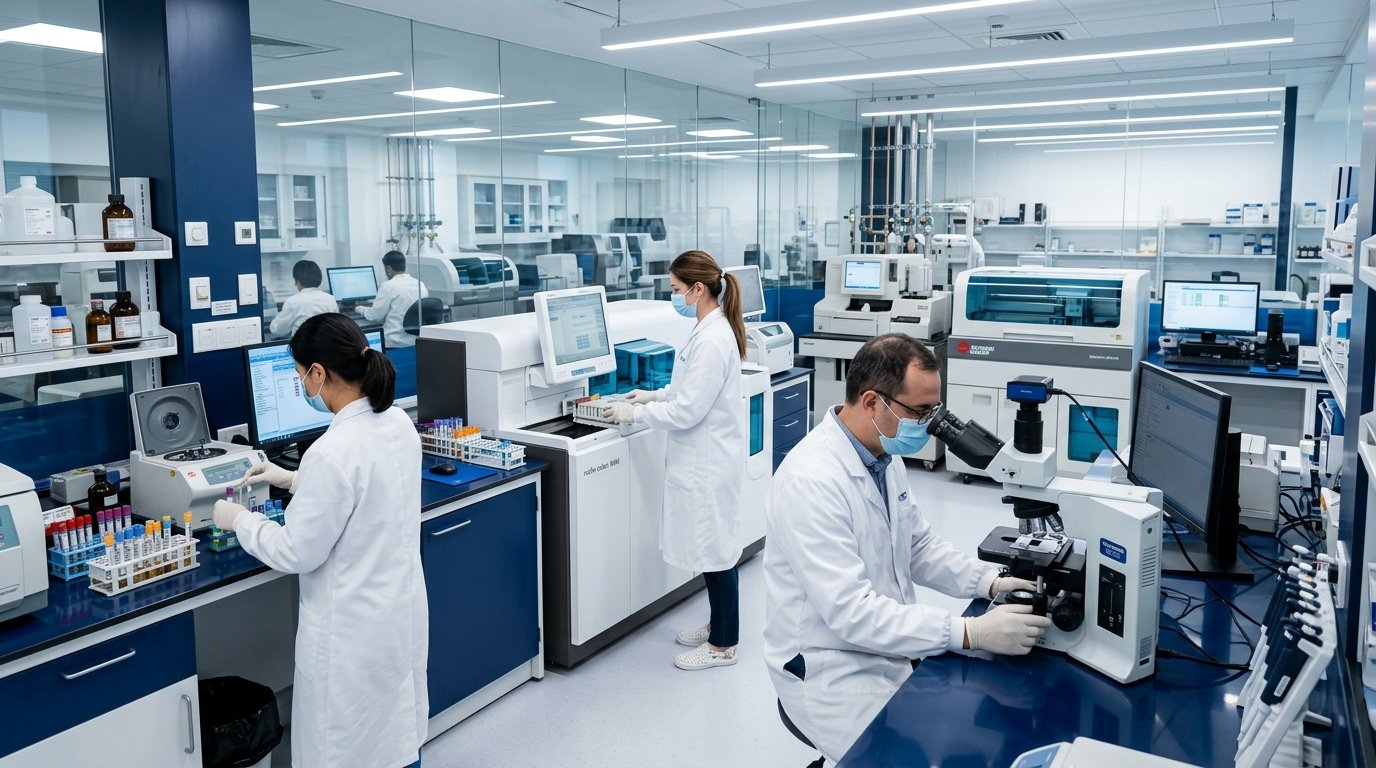
Diagnostic employers hire technicians who can operate real hardware from Day 1. Here are the core instrument suites every TMIPS DMLT student masters:
Automated Biochemistry Analyzers
Reagent loading, spectrophotometric absorbance calibration, LFT, KFT, and lipid test execution.
3-Part & 5-Part Cell Counters
Electrical impedance automated CBC testing, scattergrams, and abnormal flag verifications.
Binocular & Phase Microscopes
High-resolution oil immersion examination for malaria parasites, blood smears, and pus cells.
Rotary Microtome & Autoclaves
Precision tissue ribbon slicing for histology blocks and pressurized wet steam sterilization.
International Employment Gateway
Gulf MOH, DHA, HAAD & Prometric License Exam Roadmap for DMLT
Step-by-step guidance for Kerala and Tamil Nadu students aspiring to work in Dubai, Abu Dhabi, Saudi Arabia, Qatar, or Oman.
Step 1: Obtain DMLT Diploma & Marksheet
Graduate with your recognized 2-Year DMLT diploma, consolidated marksheet, and 6-month clinical hospital internship completion certificate.
Step 2: 1 to 2 Years Clinical Experience
Work as a Medical Lab Technician in a recognized hospital or NABL accredited diagnostic lab in India to fulfill the experience requirement.
Step 3: DataFlow PSV Verification
Submit your TMIPS diploma, marksheets, and hospital experience letters to DataFlow Group. Our fast digital registrar response guarantees a clean positive PSV report.
Step 4: Prometric / DHA Computer Exam
Clear the 100-150 MCQ computer-based technician examination (DHA Dubai, Saudi SCFHS Prometric, or OMSB Oman) with TMIPS question bank guidance.
Got Questions? We Have Answers
Frequently Asked Questions about DMLT in South India
Can Arts or Commerce students take DMLT after 12th?
For the standard 2-year professional DMLT diploma, Science stream (PCB or PCM) in 10+2 is the primary requisite. However, non-science or 10th pass candidates can enroll in the 1-Year Certificate in Medical Lab Technology / Phlebotomy Assistant program to build strong foundational knowledge and enter clinical laboratories smoothly.
Can I start my own pathology diagnostic lab after DMLT?
DMLT graduates can establish and operate collection centres and sample processing laboratory units in partnership with a registered MBBS Pathologist or MD Biochemist who signs off on final clinical diagnostic reports in accordance with the Clinical Establishments Act.
What is the total fee structure and payment timeline?
The annual tuition fee for DMLT at TMIPS is approximately ₹35,000 to ₹40,000 per year. Payments can be divided into convenient semester installments of ~₹17,500 with zero interest. Initial admission seat reservation is available for just ₹1,000.
Take Your First Step Toward Becoming a Certified Medical Lab Technologist
DMLT Admissions for 2026–27 are filling rapidly. Receive the complete syllabus breakdown, prospectus, and fee schedule directly on WhatsApp.